
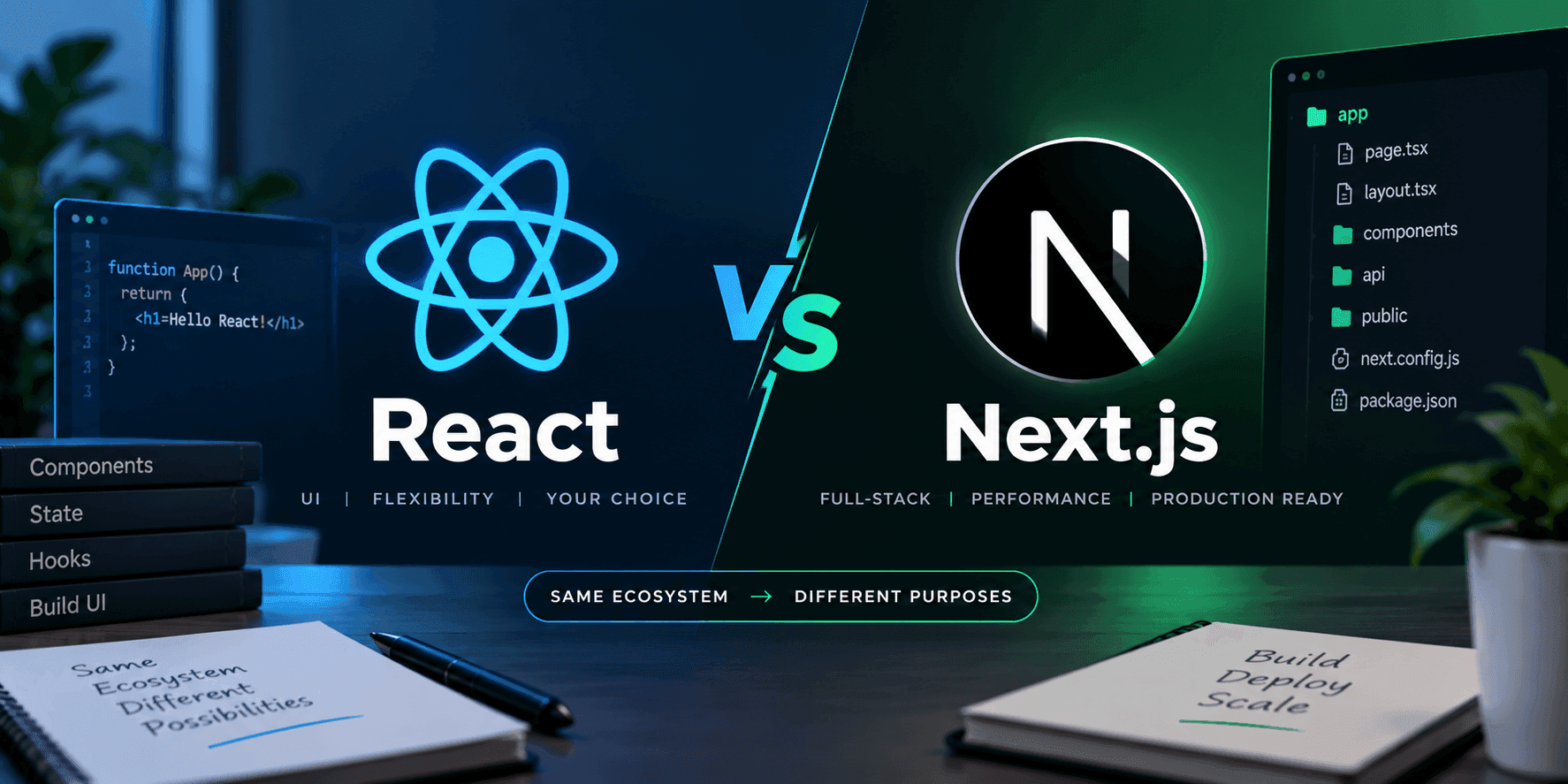

React vs Next.js is still a common question among developers in 2026. While both technologies are closely connected, they are not exactly the same thing.
React is a UI library for building component-based user interfaces, while Next.js is a React framework that provides additional features for building complete web applications, including routing, rendering, data fetching, and optimization.
What Is React?
React is a JavaScript library for building user interfaces with reusable components. It gives developers the flexibility to choose additional tools for routing, data fetching, state management, styling, and application architecture.
React can be a good choice when you want more control over your application's architecture or when you are building a focused client-side application.
What Is Next.js?
Next.js is a React framework designed for building modern web applications. It adds features and conventions around React, including file-based routing, server and client rendering patterns, data fetching, caching, image optimization, and full-stack application capabilities.
The Next.js App Router also supports modern React features such as Server Components.
React vs Next.js: The Main Difference
The simplest way to understand the difference is:
React helps you build the UI. Next.js gives you a framework for building the application around that UI.
With React alone, you typically choose and configure additional libraries and tools. With Next.js, many common application requirements are provided by the framework.
When Should You Use React?
React can be a strong fit when you are building:
- Single-page applications
- Interactive dashboards
- Internal business applications
- Client-heavy applications
- Custom frontend experiences
- Projects where you want to choose your own tooling
If your application is primarily a client-side interface and you do not need the additional features provided by a framework, React can be a practical choice.
When Should You Use Next.js?
Next.js is often a better fit when your application needs a broader web application framework.
Consider Next.js for:
- SEO-focused websites
- Blogs and content platforms
- E-commerce applications
- Marketing websites
- Large production web applications
- Full-stack React applications
- Applications requiring server-side capabilities
Next.js provides routing, rendering, optimization, and other application-level capabilities without requiring you to assemble everything yourself.
React or Next.js for SEO?
If SEO is an important requirement, Next.js provides built-in rendering and application features that can make it easier to build search-friendly web applications.
This is especially useful for blogs, documentation websites, portfolios, news websites, and other content-driven platforms where pages need to be discoverable by search engines.
React or Next.js for a Full-Stack Application?
If you are planning to build a complete application with frontend and server-side functionality, Next.js can provide a more integrated development experience.
However, React can still be used with a separate backend such as NestJS, Express, Laravel, or Django. In that architecture, React focuses on the frontend while the backend handles APIs, authentication, business logic, and database operations.
So, Which One Should You Choose in 2026?
There is no universal answer. The right choice depends on your project requirements.
Choose React when you want a flexible UI library and prefer to build your frontend architecture with your own set of tools.
Choose Next.js when you want a more complete React framework with routing, rendering strategies, optimization, and full-stack capabilities.
React gives you flexibility. Next.js gives you a structured application framework built around React.
Final Thoughts
React and Next.js should not be treated as direct competitors. In fact, Next.js is built on React and extends it with additional application-level capabilities.
For developers learning modern web development, understanding React fundamentals first and then learning Next.js can provide a strong foundation for building production-ready applications.


