

Becoming a Full-Stack Developer means learning how modern web applications work from the user interface to the server, database, and deployment infrastructure.
You do not need to learn every technology available. The goal is to build a strong foundation, choose a practical stack, and gradually develop the skills needed to build and maintain production-ready applications.
1. Start with Web Fundamentals
Before learning frameworks, understand the core technologies of the web.
- HTML and semantic markup
- CSS and responsive design
- JavaScript fundamentals
- HTTP and HTTPS
- Browser and DOM basics
- Git and GitHub
A strong foundation makes learning modern frameworks much easier.
2. Learn a Modern Frontend Stack
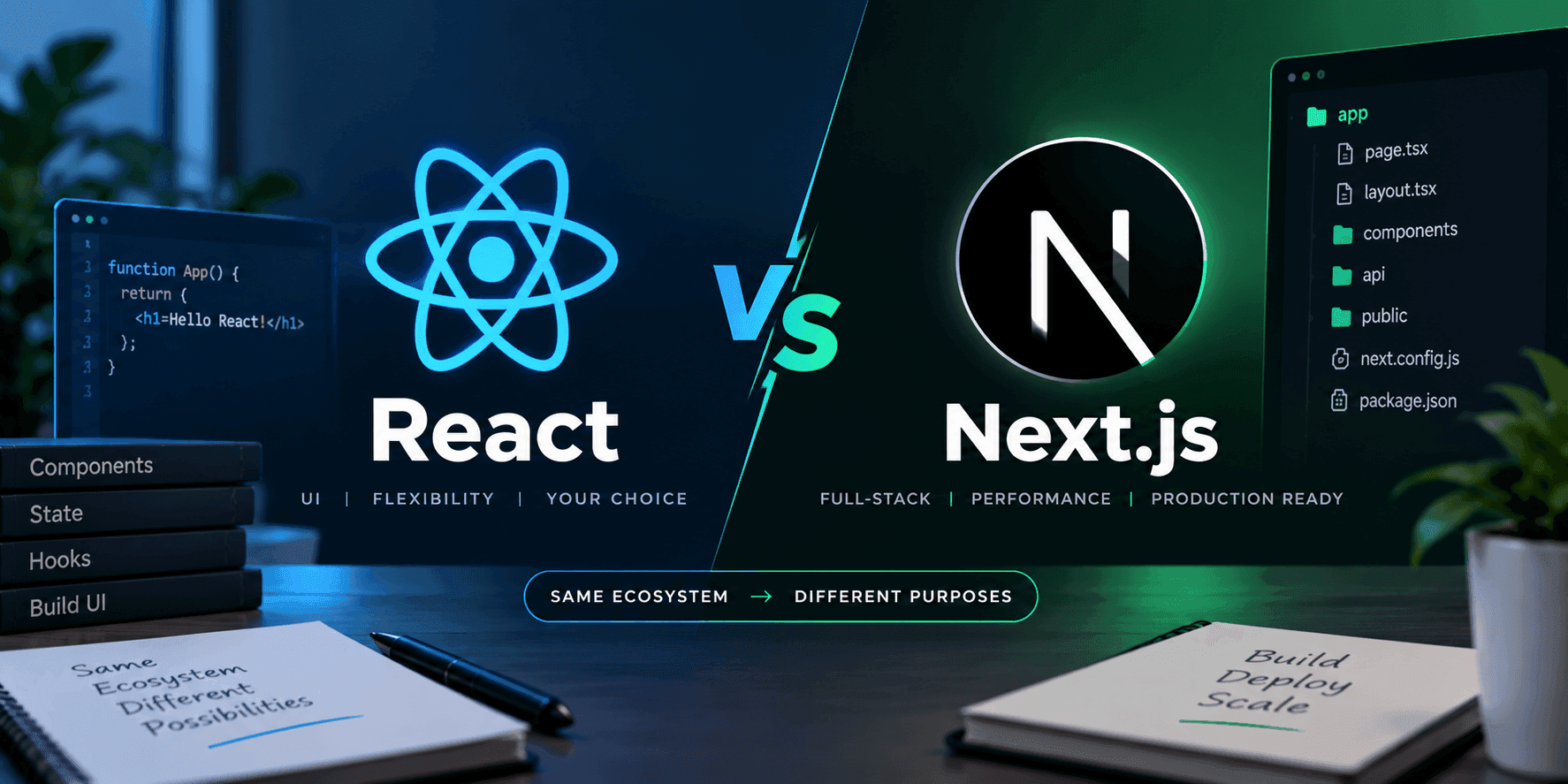
After mastering JavaScript, learn a component-based frontend library such as React.
Focus on components, props, state, hooks, forms, API integration, routing, performance, accessibility, and reusable UI patterns.
Then learn a framework such as Next.js to understand modern rendering, routing, server-side capabilities, and production application architecture.
3. Learn TypeScript
TypeScript is an important skill for modern production applications. Learn types, interfaces, generics, utility types, narrowing, and how to use TypeScript effectively with React and backend frameworks.
4. Learn Backend Development
Choose one backend ecosystem and become comfortable building APIs and server-side applications.
For example, with Node.js you can learn NestJS or Express. Focus on REST APIs, authentication, authorization, validation, error handling, file uploads, background jobs, and application architecture.
5. Learn Databases
A Full-Stack Developer should understand both how to use databases and how they work.
- SQL fundamentals
- PostgreSQL or MySQL
- Database relationships
- Indexes
- Transactions
- Query optimization
- ORMs such as Prisma or TypeORM
Do not depend completely on an ORM. Understanding SQL and database design is essential for building scalable applications.
6. Learn APIs and Authentication
Learn how frontend and backend systems communicate through APIs. Understand REST, HTTP status codes, request validation, pagination, filtering, caching, authentication, authorization, sessions, and token-based authentication.
7. Learn Testing
Production developers need more than code that works on their own machine. Learn unit testing, integration testing, API testing, and end-to-end testing.
Testing becomes especially important when working with AI coding agents because automated verification helps validate AI-generated changes.
8. Learn Docker and Deployment
Once you can build applications, learn how to run and deploy them.
- Linux fundamentals
- Docker
- Nginx
- Environment variables
- CI/CD
- Cloud platforms
- Application monitoring
You should eventually be able to take an application from development to a production server.
9. Learn System Design
As your experience grows, start learning how large applications are designed.
Study scalability, caching, load balancing, queues, Redis, database scaling, microservices, logging, monitoring, and distributed systems.
You do not need to start with complex microservices. First learn how to design a clean and scalable monolithic application.
10. Learn AI-Native Development
In 2026, Full-Stack Developers can also benefit from learning how AI coding tools and agents fit into the development workflow.
Explore tools such as AI coding assistants and coding agents, while learning how to use them responsibly for planning, implementation, testing, debugging, documentation, and code review.
The goal is not to depend on AI for every decision. Instead, learn how to combine developer expertise, AI agents, automation, and verification.
A Practical Learning Order
A simple roadmap can be:
HTML → CSS → JavaScript → Git → React → TypeScript → Next.js → Node.js → Backend Framework → SQL → PostgreSQL → APIs → Authentication → Testing → Docker → Deployment → System Design → AI-Native Development
Build Projects Along the Way
Do not learn these technologies only through tutorials. Build real projects as you progress.
Start with a small application, then build an authentication system, e-commerce application, dashboard, SaaS product, or business management system. Each project should introduce new engineering challenges.
Final Thoughts
There is no single technology stack that every Full-Stack Developer must learn in 2026. Strong developers understand fundamental concepts and can adapt to different tools and frameworks.
Focus on fundamentals, practical projects, backend and database knowledge, deployment, system design, and continuous learning. Once these skills are combined, you can move from simply writing code to building complete production-ready software.